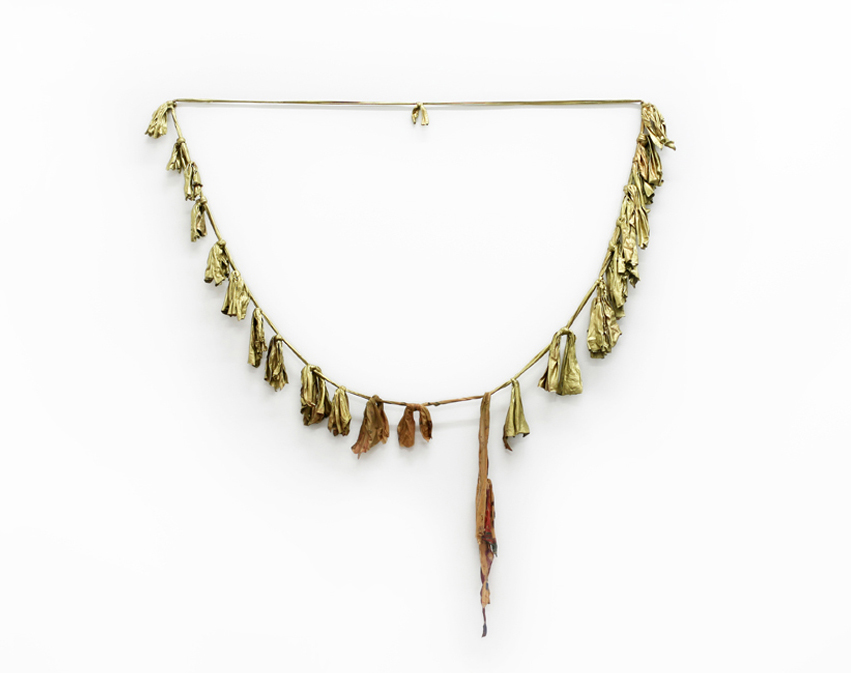
My body is fragile,
We fall in and out of portals,
I am thin-skinned,
We are rotten,
You are bitten,
cracked, and bruised.
over-ripe from the good times
too fresh for a war
You are sensitive to the mirror,
I’m allergic to the moon,
Together tangled in braided light,
There are holes in the sky,
We are winding together in spaces,
Adapting to meet the day, that melts and falls away.
-April Street
November 16, 2019- January 12, 2020 April Street solo exhibition, " The Lady of Shalott" at Susanne Vielmetter LA Projects Los Angeles CA The Lady of Shalott, April Street's second solo exhibition at the gallery. Comprised of 16 fabric-relief paintings, the works in the exhibition meld landscapes with corporeal elements to create portrait-like vignettes where waterfalls cascade into braids and hair extensions, surreal forms and voluminous lines define space and hyper-sexualized otherworldly elements rise inside and throughout her multi-dimensional surfaces.
Street's paintings are physically topographical, stuffed with fabric, morphing figuration and abstraction into hybrids of body and land. Embracing the material experimentation found in the feminist art practices of the 60s and 70s, Street uses nylon hosiery to push the physical bounds of painting while simultaneously intertwining historical and literary narratives. Street's Lady of Shalott recalls and conflates in imaginative ways the idealized "World Landscapes" of the Flemish Renaissance with the rewrite of Alfred Lord Tennyson's poem "Lady of Shalott," which inspired Pre-Raphaelite painters.
In the poem, Tennyson's Lady is imprisoned on the island of Shalott. Cursed to view the world through a mirror, weaving only what she sees reflected – Lady of Shalott chooses to look out the window at reality, provoked by the beauty of Sir Lancelot in her mirror – which she knows will cause her own death. Street takes the rewrite of the poem as a metaphor to reflect on relationships between nature, feminism, and painting. Ultimately these works are a place for Street to ruminate upon and expose culturally imposed distinctions between the monumental and the intimate, masculine and feminine, convention and inspiration.
The Mariner's Grand Staircase (Armoured Stars, Flying Clouds)
April Street
August 18, 2018- Feburary 14, 2019
SBMA Park Project, Santa Barbara Museum of Art
Birds, myths, and star charts are among the tools used to navigate the world by sea in the centuries of exploration that pre-date modern GPS and locational technologies. These and other navigational motifs appear in April Street's installation for the SBMA Park Project Series. Inspired by the architecture of the Park Projects Staircase, which recalls the grand staircases of old mansions, and Santa Barbara's location by the sea, April Street dove into research concerning the history of exploration and commerce by sea. During the days of the California gold rush, in 1851, navigator Eleanor Creesy along with her husband, Captain Josiah Perkins Creesy Jr., set sail on the maiden voyage of the clipper ship Flying Cloud, traveling from New York to San Francisco in only 89 days. This voyage was completed in record time, without the convenience of a short cut through the Panama Canal (which would not be used until 1914,) due to Eleanor's unique navigational skill. While researching the Creesy's journey, Street became fascinated by the Captain's wife, Eleanor, not only for the unique position she held as a 19th century woman, but by the strange tools of her trade and uses both as a springboard to tell her Mariner's tale.
Street's installation reimagines the Park Project staircase as the Grand Staircase in the home of a sea captain and his navigator wife. The 13 variously sized 3-dimensional abstract fabric paintings that hang on the Park Project wall are accompanied by a sound installation that records a fictional conversation between a sea captain and his navigator wife as they walk up the staircase at day's end. The two discuss the paintings on their staircase wall, in relation to the weather, the sea, celestial navigation, and their own relationship to time. The conversation moves up the physical staircase, but also backwards in time to recall each painting's origin, and forward to imagine their own future together. The conversation emerges from a background of sea-related sound effects made by the artist's own voice and a sound effects technician. Turning the stairway wall into this portrait wall of their grand staircase, Street uses her seafaring couple as stand-ins for the way an artist navigates time through pictures, creating a parallel between artist and place with the characters and their home.
April Street's Mariner's Grand Staircase consists of 13 new fabric relief paintings hung salon style on a navy wall with handmade artist frames and is accompanied by the sound piece, Armoured Stars and Flying Clouds Courtesy of the artist and Susanne Vielmetter Los Angeles Projects.
Street's work recall and combine the material experimentation of 1960s/70s feminist practices with references to the theatricality, palette, and illusionism of 17th century Dutch still-life painting. April Street continuously repurposes her paintings' material parts with displaced objects, personal narratives, and art historical references to ignite a conversation between viewer and the works about representation, duration and absence.
April Street lives and works in Los Angeles. She studied bronze casting in central Italy and painting at The School of the Art Institute of Chicago. Recent exhibitions include Susanne Vielmetter, Los Angeles, CA; Kinman Gallery, London, UK; Various Small Fires, LA; Carter & Citizen, LA; Rosamund Felsen Gallery, LA; Five Car Garage, Santa Monica; and The Underground Museum, Los Angeles. She is a grant recipient of the National Endowment for the Arts and is in the permanent collection of the Santa Barbara Museum of Art. Her solo shows have been reviewed by ArtForum, Art in America, Art Review, San Francisco Arts Quarterly, LA Weekly, Contemporary Arts Review LA, Hyperallergic and The Los Angeles Times.
*Presented in coincidence with the artist's residency at the Ridley-Tree Education Center at McCormick House apartment, and a series of interactive projects and environment designed by the artist called "Deep Sky Objects made visible for Everyone" outside of the Family Resource Center.
"The Shoulder and the Bow" APRIL STREET
January 20 - February 24, 2018
Susanne Vielmetter Los Angeles Projects is pleased to announce a solo exhibition with Los Angeles-based artist, April Street. Street's focused presentation at the gallery will include 9 new fabric-relief paintings that use artifacts of body-imprinted nylons that spring forth, in three dimensions, from hand-painted frames or are suspended from bronze nails. Street's new paintings recall and combine the material experimentation of 1960s/70s feminist practices with references to the theatricality, palette, and illusionism of 17th century Dutch still-life painting. April Street continuously repurposes her paintings' material parts with displaced objects, personal narratives, and art historical references to ignite a conversation between viewer and the works about representation, duration and absence.
Street's relief paintings emphasize an embodied process. Works in this series begin with a sequence of scripted positions for the body: she imprints her hosiery-fabric covered body into pools of acrylic paint. The paint-stained remnants of these choreographed performances are then stuffed, twisted, and re-painted; distilling the large swaths of fabric into three-dimensional paintings in a format many times smaller than their original yardage.
In Street's work, nothing is as it seems. She constructs dialogues within these not-so-still-lifes that simultaneously allude to the human body and celestial bodies. Their material illusionism suggesting first fabric, then food or objects on a table, then a figure in a landscape.
The relief paintings are a direct evolution from Street's previous series titled Wandering Limbs. Where those previous paintings explored the absence of the body, her new work insists upon physicality and presence; some semblance of its own embodied psychological awareness. Rich color traverses the swelling protuberances of the relief paintings, urging a renewed exploration of painting's physical manifestation in space.
Cassiopeia loves Grimaldi
April Street
LA based artist April Street explores notions of fiction and absence within her debut London solo exhibition Cassiopeia loves Grimaldi. Street constructs fictional relationships that consider both the tragic and the comic whilst making reference to mythology, theatrical performance and the history of painting. The exhibition lends its title from the constellation 'Cassiopeia', which is rooted with Greek mythology and the British actor / comedian Joseph Grimaldi, who became one of the most renowned entertainers of the Regency era in the United Kingdom.
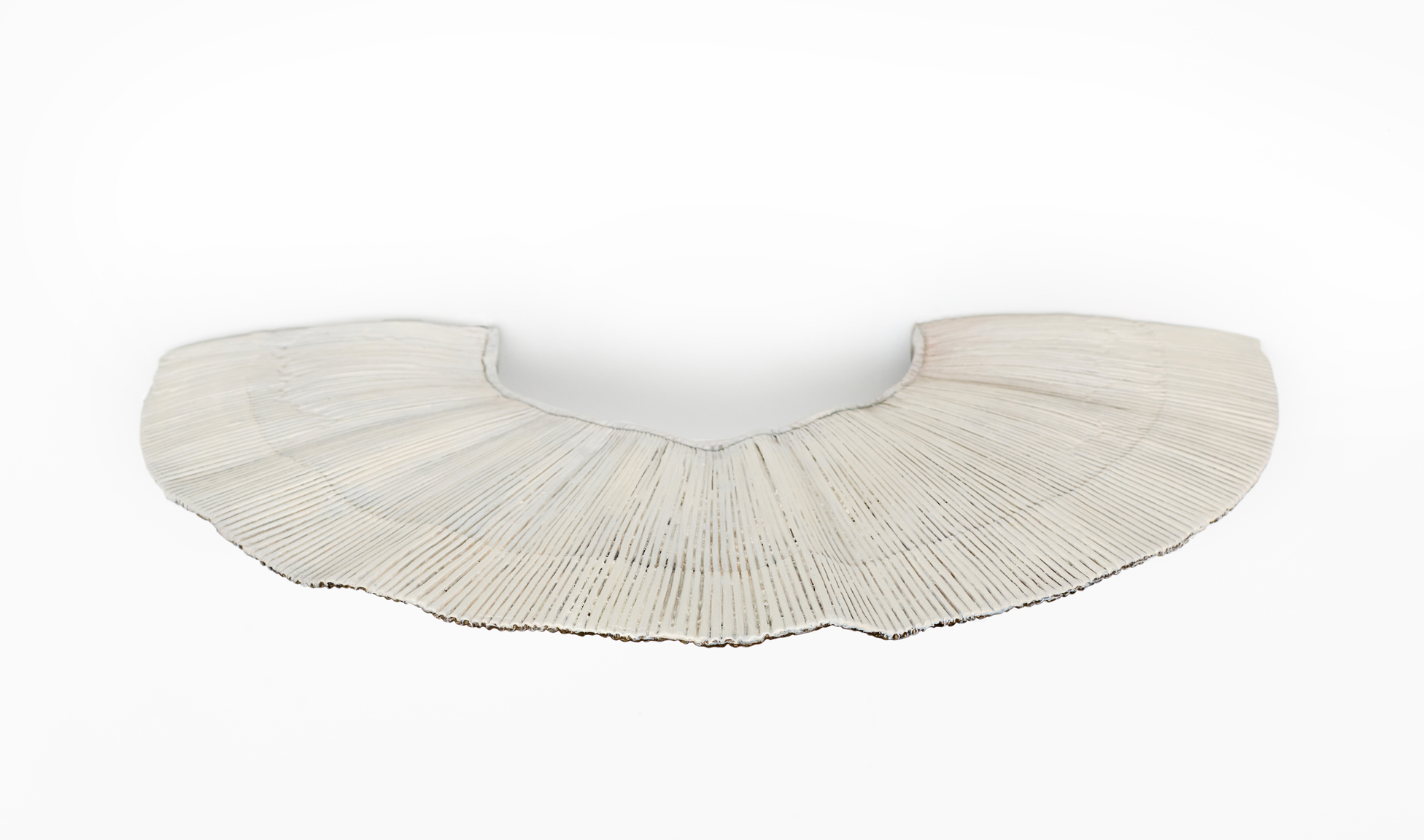
The constructed dialogues within the exhibition allude towards the absent characters; a large celestial mural occupies a substantial proportion of the gallery, whilst cast bronze ruff collars suggest regal and thematic references. Street has produced a number of relief paintings, which are deeply embodied within ideas of performativity; works from this series manifest from a sequence of scripted positions, where Street imprints her body into pools of acrylic paint, whilst being partially wrapped in yards of hosiery fabric. The residue of these choreographed performances are then reworked via stuffing, twisting and painting to produce vivid abstract wall reliefs, which recalls the feminist practices of the 60's and 70's as well as the theatrical nature of Chiaroscuro from the Baroque and Renaissance masters.
Cassiopeia loves Grimaldi is comprised of layering artefacts and objects, which nod towards a choreographed past. Whilst making stark references to prominent points within art history, Street has developed a body of work that is purposely sheafed in ambiguity, leaving a margin for play and interpretation.
April Street lives and works in Los Angeles. She studied bronze casting in central Italy and painting at The School of the Art Institute of Chicago. Recent exhibitions include Various Small Fires, LA; Carter & Citizen, LA; Rosamund Felsen Gallery, LA; Five Car Garage, Santa Monica, Santa Barbara Museum of Art and Underground Museum, Los Angeles. She is a grant recipient of the National Endowment for the Arts. Her solo shows have been reviewed by ArtForum, Art in America, San Francisco Arts Quarterly, LA Weekly, Hyperallergic and The Los Angeles Times.
Lay Down Your Arms
April Street
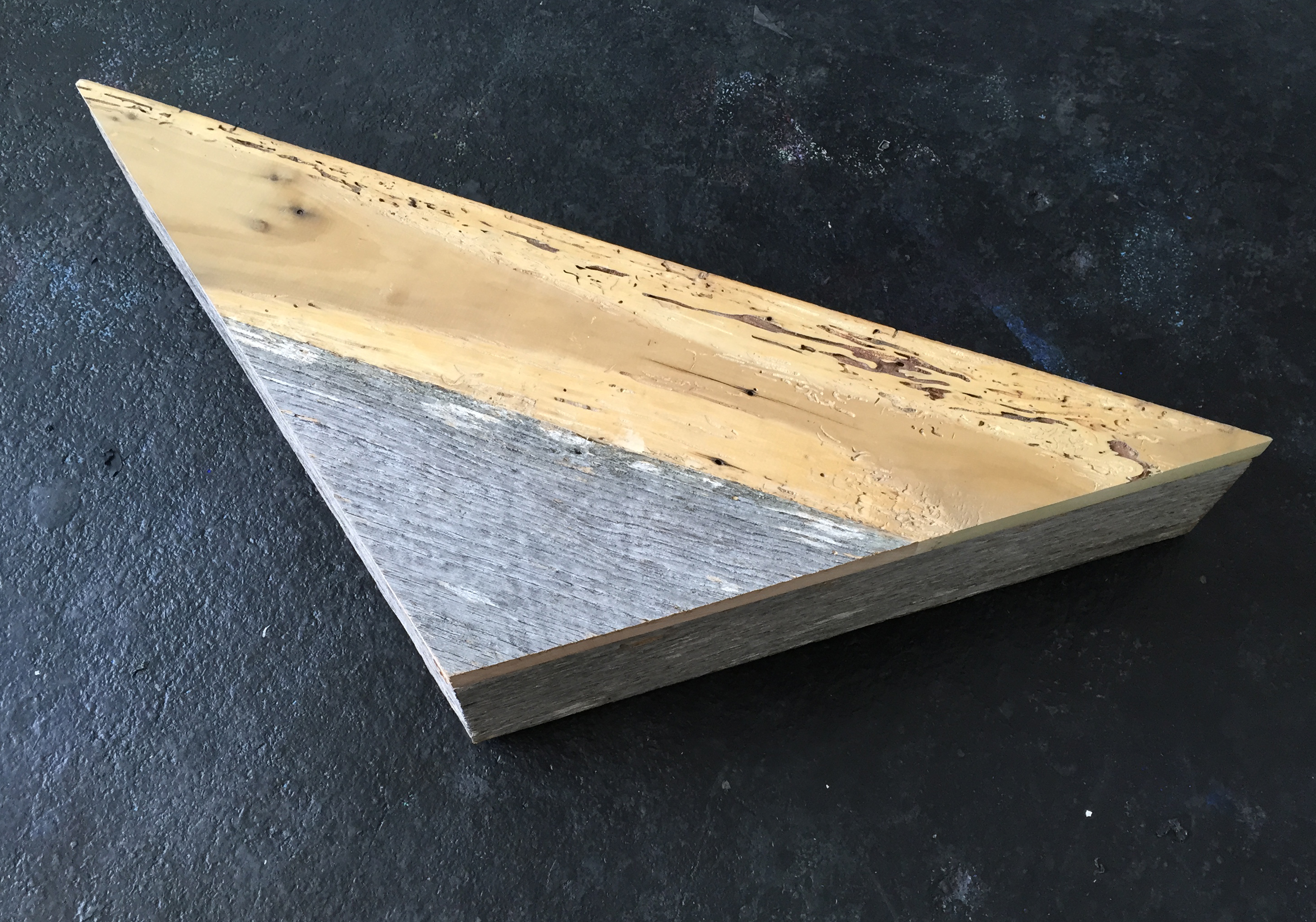
April Street a case for Wandering Limb 14 (2015), 14"x28" reclaimed wood from 1840, leather inset
-------------------------------------------------------------------------------------------------------------------------
Through April Street's continuous repurposing of her paintings material parts, she rebuilds them in a frankensteinian manner, opening up their surfaces to express not only the inner workings of the paintings history, but also to reactivate the severed limbs of a body of work to reveal the relationship that her performative paintings have with photography. Each of Street's paintings are tenuously spun into ropes, blindly cut from larger paintings and pinned to the wall as in the wandering limb series, or wrapped in black nylon with holes cut or punched through, revealing layers of paintings on hosiery material.
Street's paintings are artifacts of a private performative act in which the artist wraps herself in hosiery material to enact a series of precise body positions, recorded while sleeping, into the wet pools of an acrylic painting she creates on a canvas . The scripted impressions made by this act creates a positive and negative, and at times, the mark making results look almost photographic. The negative of the painting pressed onto hosiery is then reassembled onto the painting's frame. The canvas painting is hidden beneath the hosiery or on occasion kept by the artist in the studio. For the rope paintings, she uses the same skin-mimicking textiles as her paintings' ground, and then tightly spins the finished paintings into ropes held together only by a cast bronze knot and a bronze tack where they meet the wall or the ceiling. These spun paintings conceal most of the painting inside them and act as strands of DNA that would unravel without the weight of their fixture's weighty history.
The puncturing of the surface is made to reach inside for an understanding of how these objects can reenact a sensation of blushing or bruising skin and create the psychological territory of the painting itself. These gravitational configurations evoke a tenuous dialog between painting and sculpture about photography, while conjuring ideas of skin and duration, posturing and adaptation.
The work ignites a conversation with eccentric abstraction, feminist performance art from the 60′s and 70′s, Post-Minimalism and Art Informel, while occupying a new inner outerspace.
---------------------------------------------------------------------------------------------------------------------------